

Cui bono?
To get Ireland building, policy has to ensure everyone is pulling together

Reminder: Our monthly drinks will be on tonight upstairs in Doheny & Nesbitts from 1730 to 1930.
A healthy housing system is a bit like a healthy body. When your body gets cold, you start to shiver, heating you up. When it gets too hot, you start to sweat, cooling you down. When things are working well, all of this happens automatically without any manual intervention.
This is roughly how the housing systems of the 19th century worked. As demand rose, housing supply would rise with it. Cities did good work at enabling this through public works. As demand rose, prices rose with them. And as bodies sweat when too hot, housing markets began to churn out supply where the prices were highest. Consequently, house prices during this period were relatively flat and price per square metre actually fell, despite rising incomes (see, for example, this graph via Samuel Hughes):
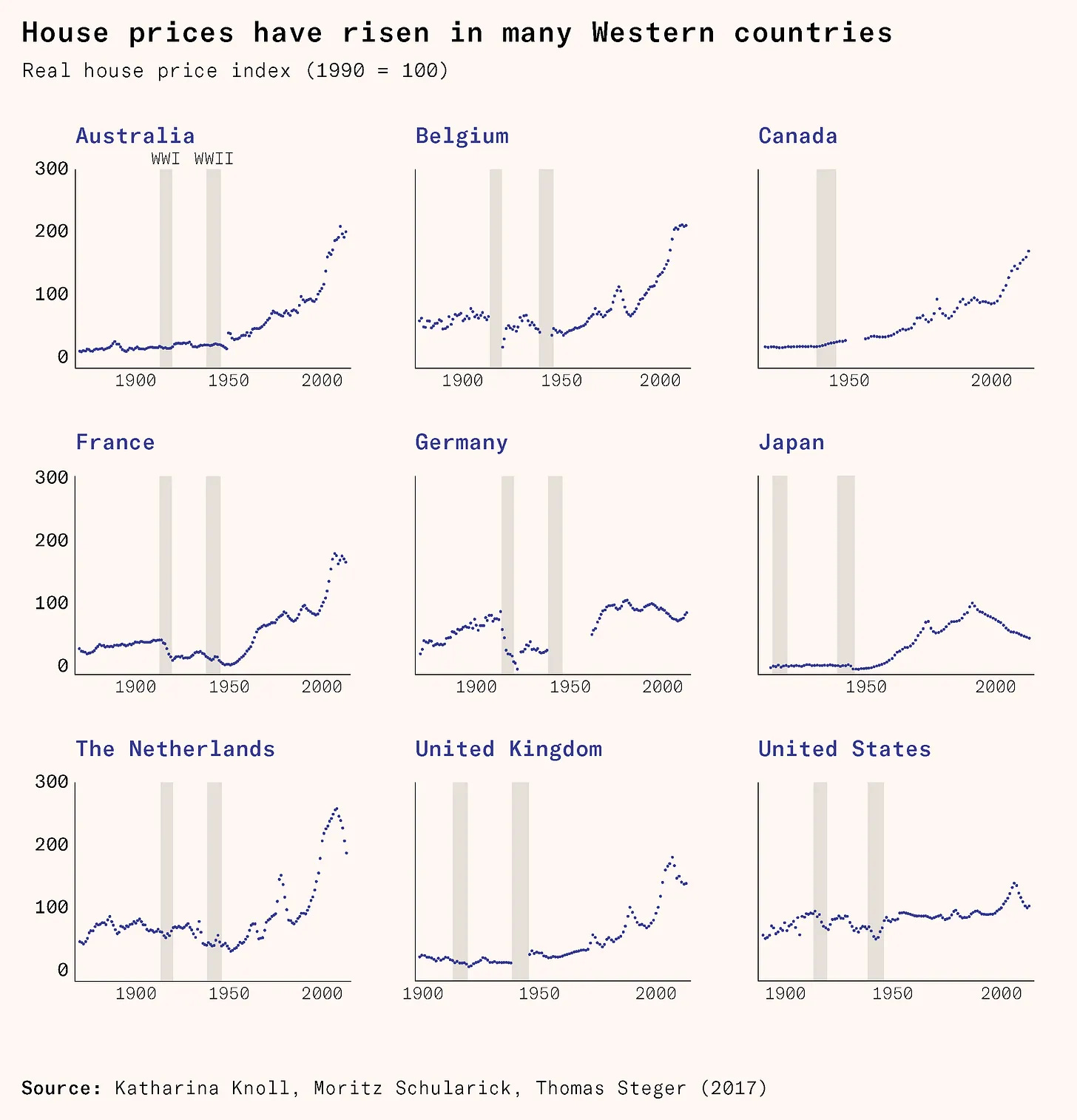
Just as sweat is the signal of excess heat, high prices are the signal that demand has outpaced supply. The high price signals that there is a shortage and, at the same time, gives an incentive to others to end the shortage. This is what economists mean when they say that prices are signals wrapped up in an incentive.
But as everyone knows, house prices are high and climbing. So, why aren’t builders building? Aren’t the high prices giving them an incentive? If it is so hot, where is all the sweat?
There are lots of ways to answer this question. For example, if you comb through Progress Ireland’s newsletter, you will hear about the high cost of construction, regulatory barriers, an undersupply of land, infrastructure problems, high taxes on dividends, and NIMBYism. These all make it harder to build things. But a simple answer to the question is: because the system does not incentivise building things.
Conflicting interests
The housing system has lots of stakeholders. There are the general public who benefit from lots of housing in the form of lower prices and higher productivity. There are locals, who bear a lot of the cost of new development. There are developers and builders, who are trying to build stuff. There are investors (whether it is the state or pension funds) who are paying for it and want to make some kind of return. There is the elected government, both local and national.
But those stakeholders are often at odds with each other. Investors are often at odds with regulators. The general public can sometimes fight with a subset of local people (think of the recent disputes around metrolink!) Locals sometimes protest the council, the developers, and the national government. National and local governments are often in open conflict.
Take national and local governments.
Local governments are closer to the ground. They are more sensitive to the median voter because small changes in local attitudes makes a big difference to whether a councillor will get returned come the next election.
When locals are unhappy with a development, they make their views known. There are lots of good reasons why locals may be unhappy but they all can be summarised as concentrated costs: locals bear the costs and do not feel any benefit. Local governments are typically hyperresponsive to these costs and, as a result, are more prone to block housing.
National governments see the big consequences of failing to build houses. They see the warning lights of macro trends of rising house prices and rents, low national output, and strains on productivity. They see that 41 per cent of 18-34 year olds across Ireland live with their parents. National governments are typically very pro-housing.
When national governments are seen to strong-arm local governments, it doesn’t tend to go well. For example, take California. One way to tell the history of Californian housing policy is that it has been a game of whack-a-mole between Sacramento and local authorities. The state government repeatedly tried to force local authorities to allow more homes and local authorities would find increasingly clever ways to continue blocking housing.
In Ireland, we have versions of this story. Right now, the Minister is trying to get councils to zone more land for housing. He is doing this through section 28 of the Planning and Development Act 2000 (as amended). That section empowers the Minister to issue guidance to local authorities. But they are, for various reasons, not compelled to follow the guidance. So, the game of whack-a-mole continues.
How houses are like taxis
Getting everyone pulling together is not magic. There is a whole field of economics dedicated to that way of thinking. It’s called mechanism design. When rules are designed so that everyone is incentivised to bring about the outcome you want, you get something like the opening analogy of a healthy body: a system that is self-sustaining.
Take the case of taxis. Between 1978 and the late 1990s, demand for taxis roughly doubled, driven by economic growth, tourism, and a crackdown on drink driving. But the supply of taxi licenses was effectively fixed. Most new entrants had to purchase a license on the second-hand market, meaning that the license-allocation system operated on a one-in-one-out basis. As a result, long queues were common with passengers routinely waiting over an hour for a taxi.
Soaring demand and restricted supply did two things. First, it meant that the value of a taxi license was artificially inflated to about £80,000 (just over €100,000 today). And second, it created a strong incentive for incumbents to argue that no licences should be awarded, lest the value of their license gets eroded.
Housing policy shares some features of Dublin’s taxi market in the 1990s. There are various stakeholders, including homeowners, who resist measures to accelerate the supply of new homes. As I have argued before, I don’t believe this is as simple as homeowners protecting their asset values, but that is certainly part of it. Homeowners equally don’t want to see their neighbourhoods change for the worse. These stakeholders are like Dublin’s taxidrivers in the 90s.
But this isn’t a moral story. Neither homeowners nor taxidrivers are bad people. Today’s homeowners and the taxidrivers of the 1990s are alike in that they are both creatures of their incentives.
John Fingleton, Progress Ireland’s latest fellow, along with colleagues proposed reforms in the 1990s. Taxidrivers were to receive an additional licence, which they could sell on the secondary market. As a result, applications for nearly 3,000 additional licences were received by the council.
The lesson here is that incentives matter. Once you see this simple point, it is difficult to unsee. Groups there were seen as once recalcitrant opponents to reforms can quickly become their biggest champion, if their incentives are aligned.
France built a world-leading nuclear power industry, in part, by sharing the benefits with local communities. Like Dublin’s taxi drivers, locals become champions of nuclear energy if their incentives point in that direction. The French achieved this, in part, by lowering taxes in the communities that hosted the reactors. Avoine, the commune that hosted the first EDF reactors, for example, saw annual revenue jump 100x in ten years.
The Japanese delivered about 30 per cent of their urban area using land readjustment, a process that allows landowners to share in the benefits of urbanisation. Farmers are typically pitted as historical opponents of urbanisation. But this was less true in Japan, due to land readjustment. As one academic put it (perhaps in an overly rosy depiction): “The essence of land readjustment is to let people and government join hands in coping with the ordeals of rapid urbanisation.”
Homeowners famously are regarded as opponents to higher density in their neighborhoods. But there are notable exceptions. In 1992 Seoul, South Korea 53 per cent of new apartments came through a profit-sharing opt-in model. Local homeowners were permitted to vote on participation in upzoning. A similar idea delivered about 25 per cent of all new homes in Tel Aviv in 2019 and 26 percent in 2020.
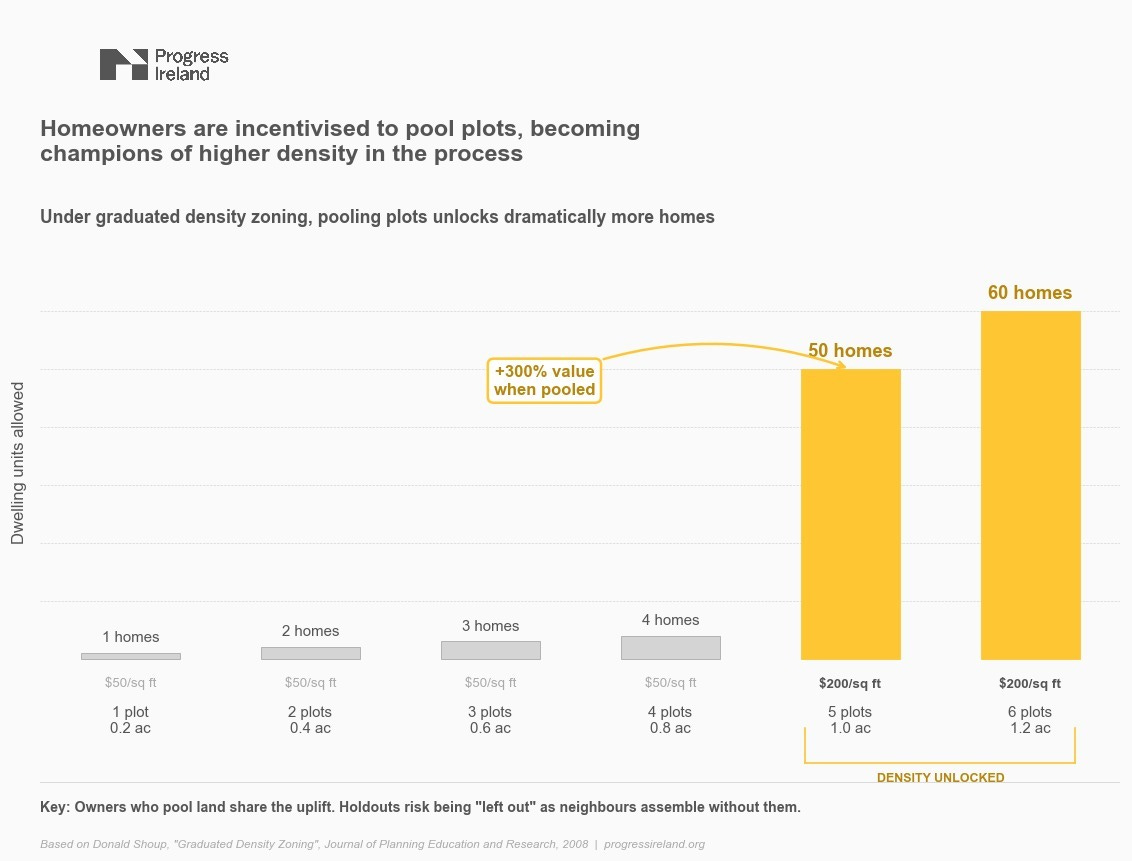
In Simi Valley, California, the city introduced a rule that allowed more homes to be built but only on larger assembled sites. On smaller sites, homeowners were stuck with low density. But when they teamed up with their neighbours and sold them together, the rules allowed them to build more together than they otherwise would be allowed to. That higher density increased the land value. And, as a result, gave homeowners a strong incentive to coordinate and sell together. This process is called graduated zoning and was created by the legendary economist, Donald Shoup.
Pulling together
There are signs that countries are beginning to internalise this lesson.
In New Zealand today, the government has recognised that to deliver the homes it needs, everyone needs to pull together. That’s why the third pillar of their housing plan, Going for Housing Growth, is focussed on aligning incentives throughout their housing system. The plan is yet to be released in full. But ideas floated include tying council funding to housing supply and automatically triggering rezoning where prices suggest substantial unmet demand.
In the United Kingdom, John Fingleton’s Nuclear report suggested that communities that host nuclear infrastructure should be allowed to specifically benefit from it. The Prime Minister has since committed to implement the Fingleton report in full.
One way to read a lot of Progress Ireland’s work is that we are looking for win-win ideas. In other words, we are looking for ways that policy can ensure different interests are pulling in the same direction. For example, we have argued for land readjustment, so landowners and the state can both benefit from land assembly; we have argued for seomraí, so that homeowners and renters can both benefit from additional rental supply; we have argued for street plan development zones, so that local communities can gradually increase density, while sharing in the value they are helping create; and we have argued for increased focus on community benefits in infrastructure delivery, so that locals who bear the costs of new infrastructure, get to share in some of its benefits.
Building stuff is hard. Most countries struggle with it. Most suffer from economic problems that make it hard to pay for the new stuff. Irish policymakers have shown that they are actually quite good at it, with increased housing supply per capita being one of the best among our peers.
But if we want to deliver the hundreds of thousands of new homes that Ireland needs, everyone has to be pulling in the same direction. To do that, policymakers have to ask: cui bono?
 | A guest post by
|
Ask who is responsible for this crime and whose incentive is it to restrict supply so investment values go up.
Go back to 2007 and you will see market forces dramatically change as ‘funds’ vultures or later REITs influence policy using fear of another crash to force restrictive or inappropriate regulation to stall developers incentives to build thus overheating the market to the criminals advantage. The HAP and RAS schemes have become a direct tap on the taxpayer to boost share price again to the criminals advantage.
It’s actually not difficult to build, look at Jack Fitzsimons legacy - anyone can do it, but we have become the only animal on the planet that is restricted from building their own home!