

How to do transit-oriented development without going bust
Lessons from Copenhagen, Japan, and Hong Kong

Ireland has a problem.
Over the past few years, we’ve decided to pursue transit-oriented development (TOD). That means concentrating urban development around public transport, creating dense pockets of apartments served by shops, restaurants, and whatever else residents need nearby.
It’s well understood that you need transit to get housing: housing that is unconnected to other houses, businesses, and amenities is much less useful. Ignoring transport would be like building a home without water, energy, or internet infrastructure. And it’s even more true when aiming for compact development.
But the problem is that TOD is expensive. Prohibitively so, in fact. We expect to spend over €10 billion on Metrolink. DART+ South West alone will be another €1 billion. Not to mention the staggering tens of billions that a full upgrade of the rail network would take.
Where does this money currently come from? There are three broad categories. First, and most obvious, is central government. The government directs its revenue into capital investment. The next two are usually less prominent but can still make a contribution. The EU spends tens of billions across the continent to knit its member states together, including with physical transport links, via grants and other financial instruments. Lastly, in general, developers can pay for the cost of servicing their development with infrastructure.
There are some ways to cut costs, but no matter what, the transport infrastructure necessary for TOD will be expensive. However, lots of places do TOD and have done for years, at times even when they had limited financial means at hand. How do they do it?
Copenhagen
In the 1990s, Copenhagen was stagnating. High unemployment was eroding the tax base and straining city finances. The working age population was increasingly abandoning the central city, leaving students and the elderly, neither of whom paid much tax.
Partnering with the national government, the city undertook a program of redevelopment. They formed a corporation and concentrated on Ørestad, a 300 hectare patch of land formerly used by the Danish military. A new metro and rezoning, it was decided, could connect the area to the capital’s downtown, making the area more attractive as a place to live and work.
How could the corporation raise the capital needed to build this new metro and redevelop the area? Increased taxes weren’t an option given the city’s economic issues. Instead, the corporation took a loan backed by the land on the project, which, crucially, appreciated in value due to the planned metro and rezoning. This made the terms of the loan more favourable than they otherwise would have been.
The corporation now had the capital it needed to build the metro, which it subsequently built successfully. The redeveloped area provides some ten thousand jobs and residents, with a long term target of eighty thousand residents as redevelopment continues. Selling or leasing the rezoned land has raised the funds needed to meet loan repayments, and in some cases the corporation has even acted as a developer itself.
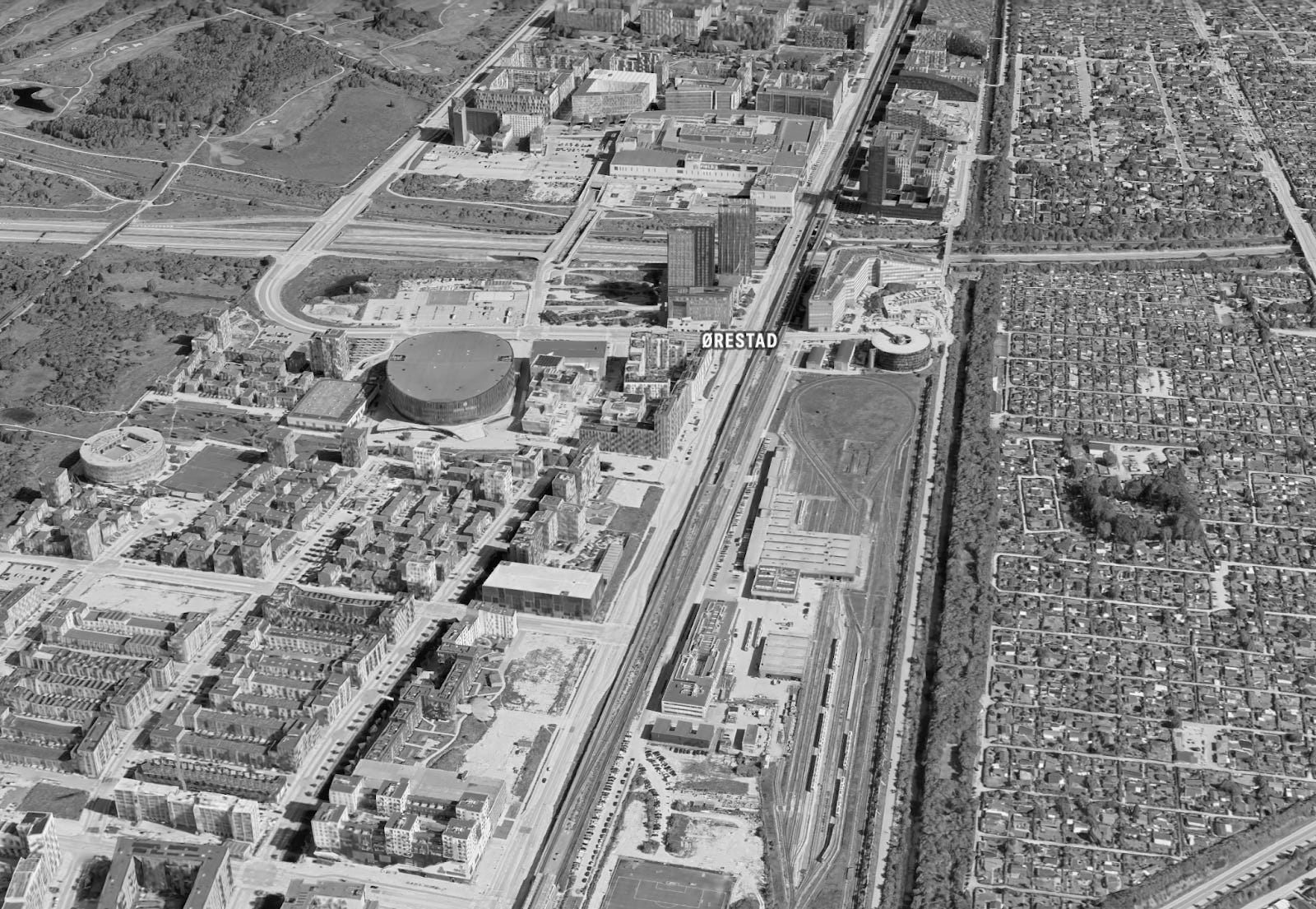
This is effectively land value capture. The government has increased the value of an area through rezoning and transport connectivity, which it then recoups by selling some of the newly-valuable land. The loan is a way of time shifting the value that is going to be created in the future to the present.
The sale of land isn’t the only way that the government can realise financial returns from their investment: the employment and business activity generated by the new area also flows into government coffers via taxes. But the loan against the new value of the land is a crucial way for the developing corporation to get the capital it needs at an early stage of development.
Japan
One response might be to argue that Ireland doesn’t have many large parcels of publicly owned land on which this kind of land value capture could be executed. But Japan shows public land ownership at the outset of a project isn’t strictly necessary.
The typical Japanese approach to developing a new urban area works as follows: the area in question is designated as a potential land readjustment site. A new plan is drawn up, showing how the land will be put to higher value uses – including some “reserve land” that the government will sell to finance the project. Landowners have a reason to give up this land, as their new, smaller plot will be worth more after the redevelopment. Once landowner consent has been given (via supermajority vote), construction work goes ahead. When complete, owners receive new, higher value plots.
The upfront costs of development can now be paid back via the sale of the reserve land. In Japan, it’s typical for at least 50 per cent of the total value uplift to be captured to pay for the project’s costs. This is the main way for the project to earn money: for example, in the Nagakute Nanbu land readjustment project, selling reserve land generated 67 percent of the project’s total revenue.
The eventual result is a new area of the city, complete with all the public infrastructure needed to make it successful and liveable.
The amount of public land generated in some Japanese cases is quite remarkable. In the Akihabara project, landowners contributed an average of 35 per cent of their land for public use, resulting in four new roads, two new plazas, and a park.

The government not owning land in the right place can appear to stymie redevelopment prospects, but Japan shows us otherwise. Public land ownership in Japanese urban areas was notably low, but land readjustment incentivised landowners to give up part of their plot to the government.
Other options for securing public land are fairly unattractive. Suspending property rights and seizing the land via compulsory purchases isn’t a scalable option, and is politically painful. Buying up land outright in cash is expensive, and still leaves the government with a challenge of paying for the necessary infrastructure upgrades.
Land readjustment offers perhaps the only realistic way for the government to own some land in cities, and use it for public benefit.
Hong Kong
Hong Kong has pioneered a third way of reducing up front development costs: rail plus property.
For context, there are two main ways for railways to be built and operated in Hong Kong. Under the ownership method, the Mass Transit Rail corporation (MTR) does everything. It designs, finances, constructs, and operates the line. Alternatively, the government can build the line and MTR pays concession fees to operate the line.
However, sometimes there is still a funding gap when it comes to building new stations. The government could try to plug the gap through grants, but this means that money won’t be available for other priorities. Is there another way to make new projects more profitable?
The solution Hong Kong arrived at is called the rail plus property program. First, the government (which owns all land in Hong Kong) grants MTR the right to develop property above and around new stations at the ‘before rail’ price. MTR can then approach developers with an ‘after rail’ value proposition, given that they know the station will be constructed. Instead of selling the land, however, it creates a long term partnership whereby MTR sells property units but remains in control of the underlying land. This helps it to grow its revenue over time to keep up with rail maintenance costs.
This approach has a series of benefits. MTR captures more of the long term value that the station generates, which is enough to bridge the financing gap that existed before. Future increased land value won’t just accrue to developers who buy at the right time, but MTR gets a share of it too as it controls the underlying land.
In addition, MTR acts as a master planner for the newly developed area, aligning all stakeholders and carrying out negotiations where needed, creating a plan for the station and its surroundings, managing properties after they’re sold. The fact that one single actor is in charge of all of this means that it has an incentive for everything to go smoothly and well. It can optimise for creating the most long term value for the station overall, rather than just one narrow aspect of the station or just one piece of the property. MTR is effectively internalising more of the positive externalities that the development of the rail station creates.
The common theme of these projects is internalising the positive externalities that transit-oriented development creates. The sale of reserve land, the accumulation of public land via land readjustment, and the rail plus property model are all premised on future gains being captured to enable development now.
If that can be done effectively, more development becomes financially possible, whether in Copenhagen, east Asia, or Ireland.
This is exactly the kind of thinking Ireland needs — but value capture alone will not prevent infrastructure projects going bust.
Before land is acquired and designs become politically or contractually “locked in”, the design team, LCA specialists and PQS/cost consultants must work within explicit Cost and Carbon Guardrails, established through credible international benchmarking and decomposed to a sufficiently granular level using ICMS 3 protocols.
Why? Because otherwise we risk optimising a design that was never affordable, deliverable or carbon-efficient in the first place.
This directly supports Pillars 3 and 4 of Ireland’s Accelerating Infrastructure Action Plan: improving infrastructure delivery capability and driving better value through productivity, innovation and reform.
The opportunity is to connect TOD + land-value capture + ICMS 3 + whole-life carbon assessment + international benchmarking from day one. Then every major design decision can be tested against a transparent baseline:
Are we still within the Cost Guardrail? Are we still within the Carbon Guardrail? If not, why not — and who approved the deviation?
That is how Ireland moves from simply funding projects to assuring value before cost and carbon become embedded in the design.
You mention that Ireland doesn’t have large banks of publicly owned land, but you omit the mention of the right of first refusal policies that successfully exist in countries like the Netherlands and Australia, giving councils priority in purchasing certain lands. Is there a reason why these long-standing policies are omitted from this article and other PI articles on land management? Perhaps I missed something